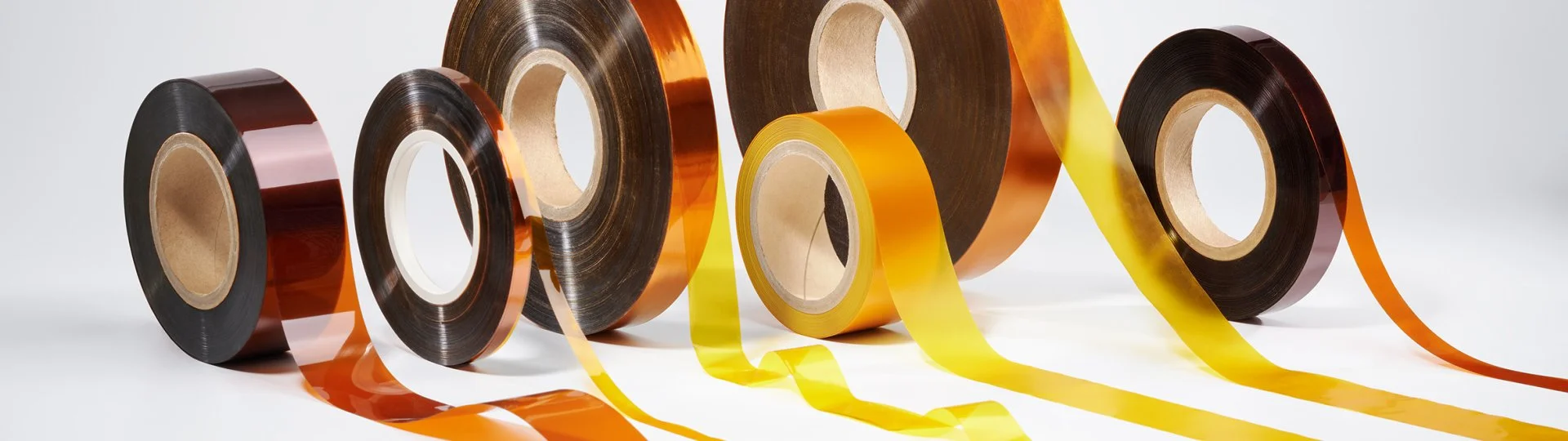
Polyimide (PI) film
Polyimide film that holds its dielectric strength from −269 °C to +400 °C
RHOPI film for motor slot and phase insulation, transformer layer insulation, flexible circuits and battery systems. Slit, sheeted or die-cut to your drawing.
- Thermal class 220 / 240
- UL 94 V-0 flame retardant
- 12.5 – 125 µm
- Die-cutting in-house
Which polyimide film grade do you need?
Five constructions cover almost every enquiry we receive. If you are replacing an existing film, tell us the incumbent grade and we will match it.
| RHOTEK grade | Comparable to | Construction | Specify it when |
|---|---|---|---|
| RHOPI.HN | Kapton® HN type film | Homogeneous PI film, 12.5 – 125 µm | General purpose slot liners, wrapping, layer insulation |
| RHOPI.FN | Kapton® FN type film | PI film with FEP on one or both sides | You need a heat-sealable or bondable film |
| RHOPI.CR | Corona-resistant PI film | PI with inorganic filler | Inverter-driven motors with fast voltage rise times |
| RHOPI.MT | Thermally conductive PI | Filled PI, raised thermal conductivity | Heat has to leave the winding, not just be insulated |
| RHOPI.AD | Polyimide adhesive tape | PI with silicone or acrylic adhesive | Masking, wire wrap, high-temperature labelling |
When polyimide is the right choice
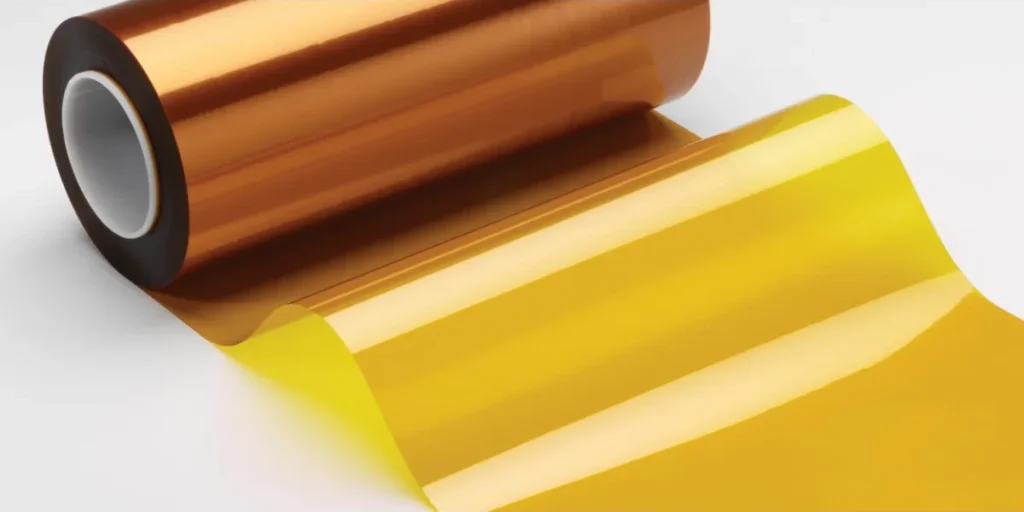
Polyimide costs more than polyester. It earns that difference in four situations, and if none of them apply we will tell you so and point you at a cheaper material.
- Above 155 °C, where PET and PEN have already given up
- Where the slot is tight and you need dielectric strength per micron, not per millimetre
- On inverter-driven windings, where fast voltage rise erodes standard film
- Where the barrier has to be flame retardant and must not melt or drip
Where polyimide film is specified
The same film does very different jobs depending on the machine. These are the applications we quote most often.
Motor slot & phase insulation
Slot liners, phase separators and closing wedges in Class H and Class C windings, including corona-resistant film for inverter-driven traction and e-drive motors.
Transformer insulation
Layer and barrier insulation in dry-type and cast-resin transformers where the thermal class allows a smaller core for the same rating.
Flexible printed circuits
Base film and coverlay for FPC and rigid-flex boards, plus carrier film through reflow.
Battery & EV systems
Cell-to-cell barriers, busbar wrap and module insulation where thermal runaway propagation has to be slowed.
Wire & cable
Helically wrapped primary insulation for magnet wire and aerospace cabling with tight bend radii.
Heaters & aerospace
Etched-foil heater substrates, and multi-layer insulation blankets for spacecraft thermal control.
Typical technical properties
Values for 25 µm general-purpose film at 23 °C, 50% RH. Full datasheets are issued with every quotation.
| Property | Test method | Typical value |
|---|---|---|
| Thickness range | Mechanical | 12.5 – 125 µm (0.5 – 5 mil) |
| Continuous service temp. | IEC 60216 | −269 °C to +240 °C |
| Short-term temperature | IEC 60216 | up to +400 °C |
| Dielectric strength | ASTM D149 | 303 kV/mm at 25 µm |
| Dielectric constant, 1 kHz | ASTM D150 | 3.4 |
| Dissipation factor, 1 kHz | ASTM D150 | 0.0018 |
| Volume resistivity | ASTM D257 | 1.5 × 10¹⁷ Ω·cm |
| Tensile strength | ASTM D882 | 231 MPa |
| Elongation at break | ASTM D882 | 72 % |
| Density | ASTM D1505 | 1.42 g/cm³ |
| Limiting oxygen index | ASTM D2863 | 37 – 45 % |
| Flammability | UL 94 | V-0, self-extinguishing |
Supplied the way your line runs
Film is only useful in the format your process accepts, so conversion happens in-house and tolerances stay ours to control. Rolls are edge-trimmed and wound to a fixed tension on your core size, interleaved and moisture-barrier packed, with a certificate of conformity in every carton.
Slit rolls
From 6 mm width, wound to your core size and roll length.
Sheets
Cut to size, interleaved and packed flat for manual insertion.
Die-cut parts
Slot liners, washers and gaskets to your drawing or sample.
Adhesive tape
Silicone or acrylic, log rolls or finished widths.
Laminates
PI bonded to aramid paper or polyester for combined builds.
Coated film
FEP one or both sides for heat-sealable constructions.
Why buyers move their polyimide film to RHOTEK
Engineering before quoting
Send the voltage class, thermal class and process. You get a grade recommendation and a datasheet, not just a price per kilo.
Samples before commitment
Trial material for your own qualification testing, so the first production run is not the first time you see the film.
Conversion under one roof
Slitting, sheeting, die-cutting, coating and laminating happen in-house, so you deal with one supplier, one specification and one point of accountability.
Documentation that passes audit
Certificates of conformity, batch traceability and test data issued with every delivery.
From enquiry to first delivery
Tell us the application
Machine type, thermal and voltage class, incumbent material if you have one, and the format you need.
Get a grade and a sample
We propose a grade with its datasheet and send trial material for your qualification testing.
Qualify and release
You test, we adjust the specification if needed, then agree tolerances, packaging and call-off schedule.
Polyimide film questions
What is polyimide film used for?
Polyimide film is used as electrical insulation wherever the temperature is too high for polyester or PEN: motor slot and phase insulation, transformer layer insulation, flexible printed circuit base film, magnet wire wrap, battery module barriers, etched-foil heaters and spacecraft thermal blankets.
What temperature can polyimide film withstand?
Continuous service is −269 °C to +240 °C, with short-term capability to +400 °C. Polyimide has no melting point; above roughly 800 °C it chars rather than melting or dripping, which is why it is classified UL 94 V-0.
What is the difference between plain and FEP-coated polyimide film?
Plain film (RHOPI.HN) is a homogeneous polyimide sheet. FEP-coated film (RHOPI.FN) carries a fluoropolymer layer on one or both sides so it can be heat-sealed. Specify it when the film has to bond to itself or to a conductor during processing.
When do I need corona-resistant polyimide film?
When the winding is driven by an inverter. Fast voltage rise times generate partial discharge that erodes standard film. Corona-resistant grades (RHOPI.CR) carry an inorganic filler that extends life under those conditions. This is standard practice in traction and e-drive motors.
What thicknesses are available?
12.5 to 125 µm (0.5 to 5 mil) as standard, with 25 µm and 50 µm being the most commonly specified. Laminated and coated constructions are thicker; tell us the finished build and we will confirm what is achievable.
Do you supply slit rolls and die-cut parts, or only master rolls?
Both. Conversion is done in-house: slit rolls from 6 mm width, sheets cut to size, and die-cut parts to your drawing or sample. Most customers buy converted material rather than master rolls.
How does polyimide film compare with aramid paper?
Polyimide gives higher dielectric strength per unit thickness and a wider temperature range; aramid paper gives better mechanical toughness and tear resistance during slot insertion. Many machines use both, laminated together in an aramid/polyimide/aramid build.
What is the minimum order quantity and lead time?
MOQ depends on grade and conversion; slit rolls of standard grades are available in small quantities for qualification. Send your requirement through the form and we will confirm MOQ, lead time and pricing for your specific build.
Get a polyimide film quote
Send the operating conditions and the format you need. Our materials engineers reply with a grade recommendation, a datasheet and a price, normally within one working day.
- Phone
- +91 20 6000 0000
- [email protected]
- Head office
-
Lodha Signet 1, Premier Colony Road
Sector Kalyan, Mangaon, Navi Mumbai
Thane, Maharashtra 421204
India
Kapton® is a registered trademark of DuPont. RHOTEK is not affiliated with DuPont. Comparable grades are listed only to help you identify an equivalent construction. All products listed are RHOTEK products manufactured to RHOTEK specifications.